This question comes up in almost every Google Ads audit.
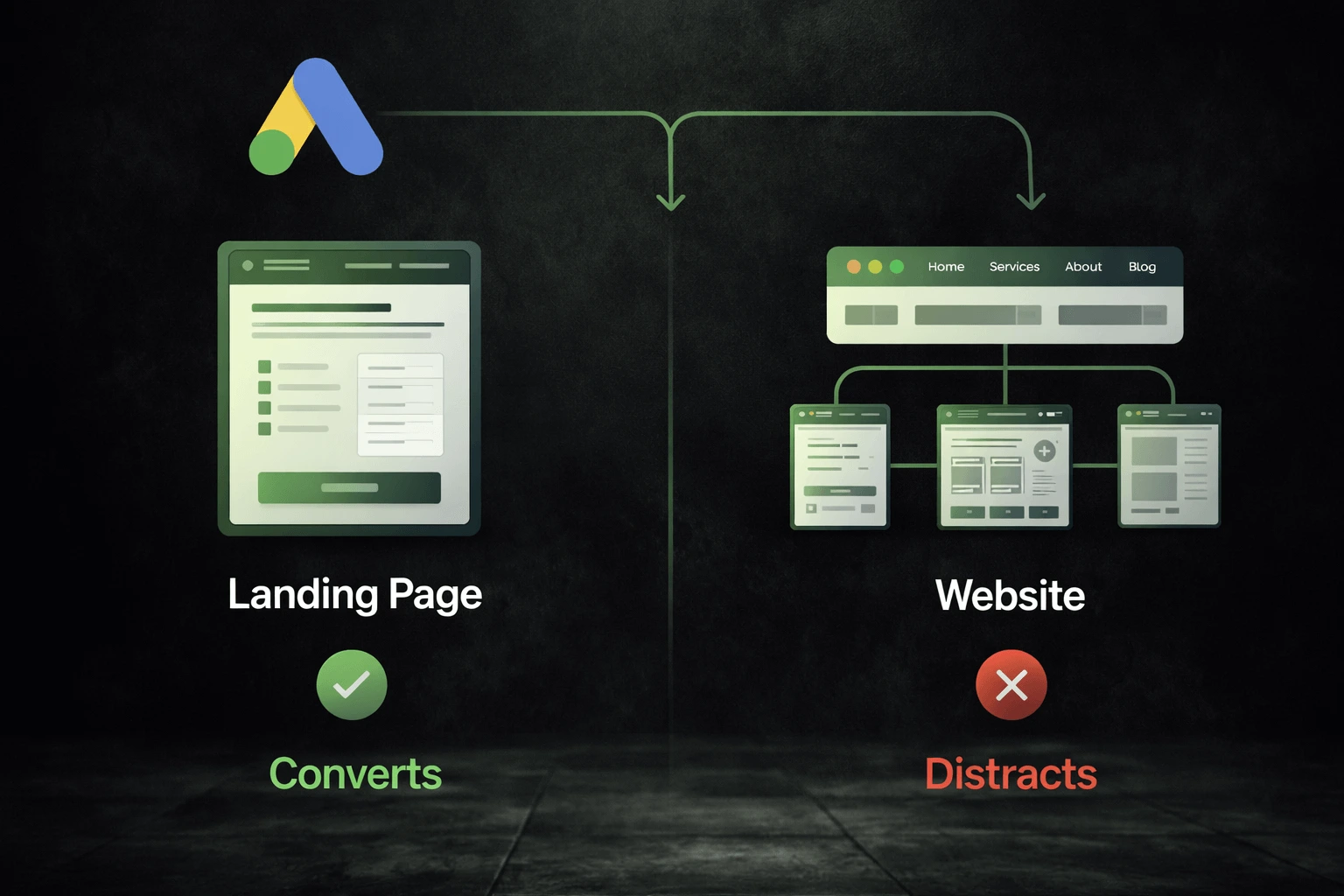
Should the ad send traffic to a standalone landing page?
Or should it link to the main website?
Most advertisers treat this as a design preference.
In reality, it’s a conversion control decision.
I’ve worked with service businesses where linking to the main website increased leads.
I’ve also seen accounts where the same choice quietly destroyed performance.
The issue is not whether linking to your website is allowed.
The issue is what problem your landing page is solving.
This article explains when linking to your website helps, when it hurts, and how to decide based on intent, friction, and system design.
The Real Purpose of a Google Ads Landing Page
A Google Ads landing page is not a mini website.
It is not a brand showcase.
It is not an information hub.
Its job is simple:
Remove doubt fast enough for a paid visitor to take action.
Everything else is optional.
When advertisers debate “website vs landing page,” they usually miss this point and optimize for comfort instead of performance.
Why This Question Exists in the First Place
Most service businesses already have a website.
Naturally, they want Google Ads traffic to:
- explore services
- learn about the brand
- browse pages
- feel confident
That instinct is logical.
But Google Ads traffic behaves differently from organic traffic.
They didn’t discover you.
They were intercepted mid-decision.
That difference matters.
What Happens When You Link to the Main Website
Linking to your website gives users freedom.
Freedom to:
- browse services
- read blogs
- check About pages
- compare offers
- delay decisions
Freedom sounds good.
But freedom is often the enemy of conversion.
Most websites are built to serve multiple audiences:
- early researchers
- repeat visitors
- partners
- job seekers
- low-intent browsers
Google Ads visitors are not most visitors.
They are decision-adjacent.
When you drop them into a general website, three things usually happen.
1. Attention Scatters
Navigation menus, footers, internal links, and multiple CTAs all compete for attention.
Instead of answering:
“Should I book this?”
The site asks:
“What do you want to explore?”
Exploration kills momentum.
2. Intent Gets Diluted
A paid visitor clicked because of a specific promise:
- a service
- a price
- a solution
- an urgency
Most websites do not maintain that promise page-to-page.
Message continuity breaks.
When continuity breaks, confidence drops.
3. Tracking Becomes Noisy
Websites generate many actions:
- page views
- scrolls
- button clicks
- time on site
None of these equal intent.
Google’s algorithm learns from outcomes, not activity.
The more paths you give users, the harder it becomes to teach Google what success actually looks like.
Why Dedicated Landing Pages Exist
Landing pages are not a trend.
They exist because paid traffic needs:
- focus
- clarity
- speed
- reduced choice
A good Google Ads landing page does not ask users to explore.
It asks them to decide.
That decision could be:
- submit a form
- call
- message
- book
Everything on the page supports that single outcome.
Should You Ever Link a Landing Page to Your Website?
Yes.
But only intentionally.
Linking is not inherently bad.
Uncontrolled linking is.
Here are situations where linking makes sense.
Case 1: High-Trust, High-Ticket Services
For expensive or sensitive services, users may need reassurance.
In these cases:
- discreet links to About
- credentials
- testimonials
- compliance pages
can help reduce anxiety.
The key is placement.
Links should:
- support trust
- not compete with the primary CTA
- not redirect users into browsing mode
Case 2: Brand-Driven Search Campaigns
If the user already searched for your brand:
- they expect a website
- they want confirmation, not persuasion
In these cases, a website page can outperform a rigid landing page.
The intent is navigational, not evaluative.
Case 3: Early-Stage Discovery Campaigns
For top-of-funnel campaigns:
- educational offers
- guides
- long consideration cycles
A website experience can be appropriate.
But this requires separate campaigns and expectations.
Blending this traffic with lead-focused campaigns is a common mistake.
When You Should NOT Link Out
You should avoid external links when:
- the service is transactional
- urgency matters
- competition is high
- budgets are limited
- conversions need to be predictable
In these cases, every link is a leak.
The Hidden Cost of “Just in Case” Links
Many landing pages include links because:
- “users might want more info”
- “it feels restrictive”
- “this is how websites work”
These are emotional decisions.
Google Ads is an economic system.
Every unnecessary link:
- increases hesitation
- extends decision time
- reduces signal clarity
- weakens algorithmic learning
You don’t lose conversions dramatically.
You lose them quietly.
A Better Way to Think About the Question
Don’t ask:
Should my landing page link to my website?
Ask:
What uncertainty does this visitor still have?
If the landing page already answers:
- price
- scope
- logistics
- credibility
- next steps
Then linking out adds nothing.
If a link reduces uncertainty without distracting, it may help.
The decision is functional, not philosophical.
How High-Performing Accounts Handle This
They don’t debate.
They test intentionally.
- Controlled variants
- Isolated traffic
- Clean conversion tracking
- Clear success metrics
And most importantly:
They separate campaigns by intent, not convenience.
Final Insight
Google Ads landing pages are not about control.
They are about decision efficiency.
Linking to your website is not wrong.
Linking without intent is.
The more focused your post-click experience is, the faster:
- users decide
- Google learns
- performance stabilizes
Paid traffic rewards clarity.
Not optionality.
Quick Audit Offer
If your Google Ads traffic is landing on pages but not converting consistently, I can review your landing page setup and post-click flow to identify where users are dropping off. I focus on intent alignment, friction reduction, and signal clarity because those elements decide whether paid traffic turns into real leads.
Send me a message if you want an experienced Google Ads specialist to take a focused look at your landing page strategy.