
Most advertisers want to know what their competitors are doing in Google Ads.
What keywords they bid on.
What ads they’re running.
What landing pages they’re using.
That curiosity is healthy.
But most people approach competitor research the wrong way. They look for shortcuts, secret tools, or exact copies, and end up learning nothing useful.
The goal of competitor analysis is not to copy ads.
It’s to understand why certain competitors keep showing up and keep paying.
This article explains how to analyze winning competitors in Google Ads without guessing, copying blindly, or misleading yourself with surface-level data.
First: What “Spying” Actually Means in Google Ads
You cannot see:
- exact keywords
- bids
- budgets
- conversion data
- Quality Scores
Anyone claiming otherwise is selling tools, not truth.
What you can observe is behavior.
Google Ads leaves behavioral fingerprints:
- consistency
- positioning
- intent focus
- offer structure
- message hierarchy
Winning advertisers leave patterns behind.
Your job is to recognize those patterns.
Why Copying Competitors Usually Fails
Many advertisers open a spy tool, export ads, and rewrite them.
This almost always underperforms.
Why?
Because ads don’t win in isolation.
They win as part of a system:
- keyword intent
- landing page logic
- conversion tracking
- bidding strategy
- economics
You’re seeing the output, not the engine.
Competitor research only works when you reverse-engineer decisions, not assets.
Step 1: Identify Who Is Actually Winning
Not every advertiser showing ads is successful.
The key signal is consistency.
A competitor running ads:
- every day
- for weeks or months
- across multiple searches
is paying Google willingly.
That alone filters out 80% of noise.
Ignore:
- one-off ads
- seasonal tests
- aggressive copy without longevity
Longevity indicates profitability or at least acceptable economics.
Step 2: Analyze Search Behavior, Not Just Ads
Search for your core service repeatedly.
Pay attention to:
- who appears at the top
- who appears consistently
- who shows different ads for different queries
Winning advertisers usually:
- tailor messaging by intent
- adjust language across queries
- avoid generic headlines
This tells you they’re structuring campaigns intentionally, not broadly.
Step 3: Use Auction Insights for Ground Truth
Auction Insights is one of the most underused tools in Google Ads.
It tells you:
- who overlaps with you
- impression share trends
- who is gaining or losing presence
- how aggressive competition really is
This data is real.
If a competitor:
- has stable overlap
- high impression share
- consistent outranking
they’re not guessing.
They’ve found something that works.
Step 4: Study Landing Pages Like a Conversion Analyst
Most advertisers glance at landing pages.
Winning advertisers dissect them.
Look for:
- how quickly the offer is clear
- how price is framed
- what objections are answered
- what is intentionally missing
- how many decisions are allowed
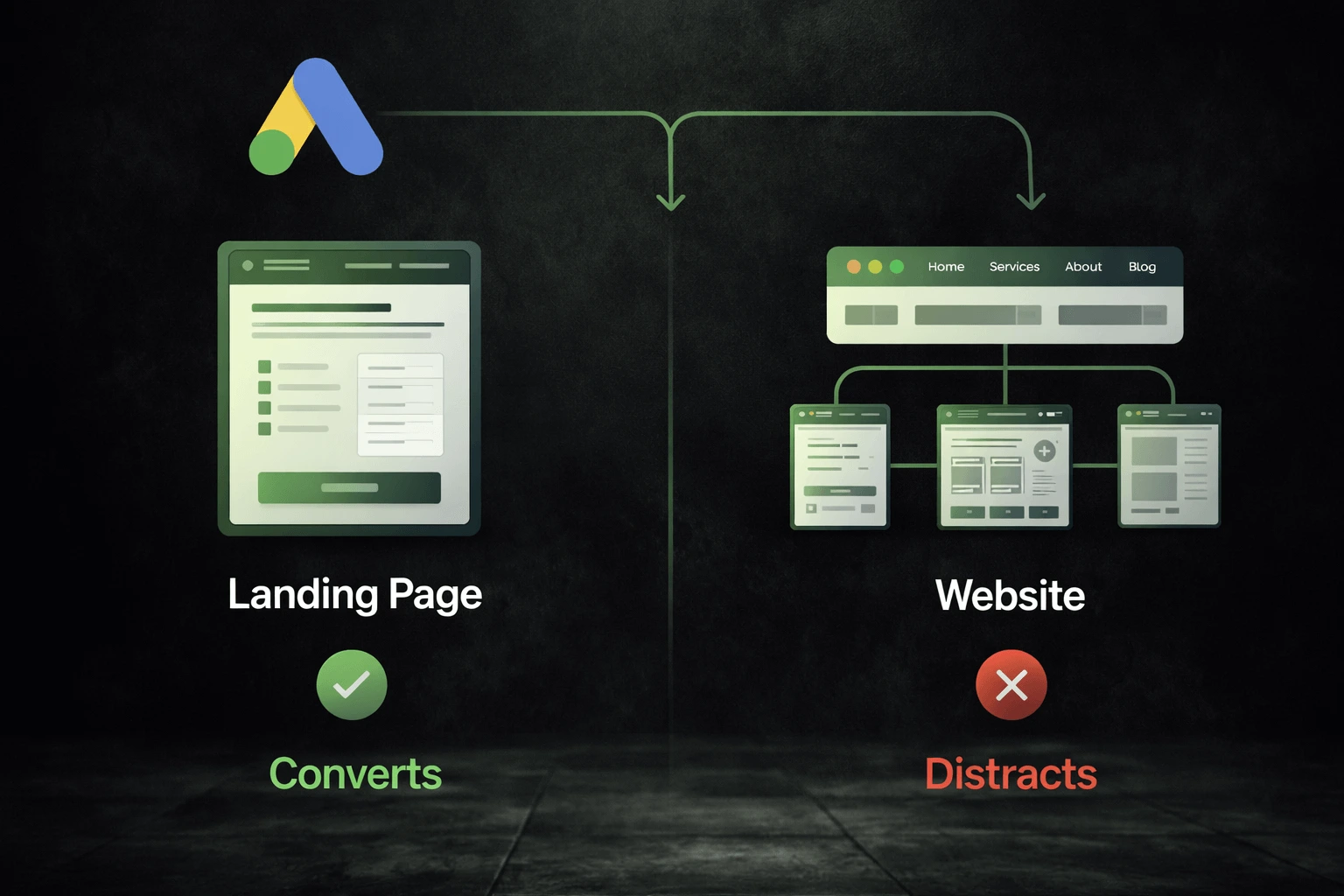
Strong landing pages usually:
- remove navigation
- reduce choice
- focus on logistics and clarity
- avoid brand storytelling
Weak ones rely on persuasion.
Winning ones rely on certainty.
Step 5: Observe What They Don’t Say
This is where most people miss the signal.
Pay attention to:
- what features are excluded
- what guarantees are avoided
- what claims are conservative
- what language feels operational, not emotional
Experienced advertisers avoid:
- exaggerated promises
- vague benefits
- risky claims
Because compliance, refunds, and lead quality matter at scale.
Silence is often intentional.
Step 6: Look for Structural Patterns Across Competitors
One competitor can mislead you.
Patterns across competitors reveal truth.
Ask:
- Are prices shown or hidden?
- Do most push calls, forms, or WhatsApp?
- Do they emphasize speed, trust, or availability?
- Are ads benefit-heavy or logistics-heavy?
When multiple advertisers converge on similar structures, that’s not coincidence.
That’s market learning.
Step 7: Translate Insights Into Strategy — Not Copies
Never ask:
“How can I copy this ad?”
Ask:
“What decision is this ad helping the user make?”
Translate insights into:
- clearer intent segmentation
- better landing page focus
- stronger qualification
- reduced friction
- more honest messaging
Your version should fit your economics, not theirs.
What Tools Are Actually Useful
Tools are helpers, not answers.
Useful for:
- identifying competitors
- tracking ad variations
- observing messaging shifts
Not useful for:
- deciding strategy
- setting bids
- choosing keywords blindly
The best insights still come from:
- live searches
- auction data
- landing page analysis
- pattern recognition
Common Mistakes in Competitor “Spying”
Avoid these traps:
- copying headlines word-for-word
- assuming high visibility equals profitability
- chasing every competitor move
- reacting instead of designing
Competitor analysis is diagnostic, not reactive.
Final Insight
Winning Google Ads accounts are rarely secret.
They’re just well-aligned.
Competitors don’t beat you because they know something magical.
They beat you because:
- their intent is clearer
- their funnel is tighter
- their signals are cleaner
- their decisions are simpler
Spying works when it sharpens your thinking.
It fails when it replaces it.
If you understand why competitors win, you don’t need to copy them.
You out-design them.
Quick Audit Offer
If your Google Ads campaigns are active but competitors keep outranking or outlasting you, I can review your account to identify where you’re losing ground. I focus on competitor positioning, intent alignment, and structural gaps, because those factors decide whether an account scales or stalls.
Send me a message if you want an experienced Google Ads specialist to audit your campaigns and show you where the advantage actually lies.