
Calls, WhatsApp clicks, and forms combined
Maintained across 12 months
Increase in monthly leads

This case study covers a live Google Ads campaign for a Dubai Desert Safari business, analyzed over a full rolling year (Jan 1, 2025 to Dec 31, 2025).
The campaign is still running successfully.
The objective was not just lead volume, but consistent confirmed bookings at a controllable CPA, in one of the most competitive tourism niches in the UAE.
Industry: Dubai Desert Safari experiences combining adventure and cultural activities, including dune bashing, camel rides, BBQ dinners, live entertainment, and sunset views.
Location: Dubai and Sharjah
Pricing Range: AED 80 to AED 900
Multiple packages based on: Experience level, Time of day (morning, evening, overnight), Private vs shared tours
Booking Model:
Customers booked through three primary paths:
Phone calls
Booking form
Each channel served a different intent level:
WhatsApp for clarification and reassurance
Phone calls for urgency or confirmation
Forms for users already clear on what they wanted
A critical nuance in this account was conversion inflation.
One user could:
Click WhatsApp
Make a phone call
Submit a form
All three actions were counted as primary Google Ads conversions.
This meant:
Google Ads conversion volume was always higher than confirmed bookings
Conversion count alone was not a reliable success metric
The true business KPIs were:
Confirmed bookings
Cost per confirmed booking (CPA)
Instead of hiding this, the strategy was built around it.
The campaign was built from scratch.
Key constraints at launch:
Very limited initial budget
Strong seasonality, especially during extreme summer heat
Highly competitive market with aggressive bidding
Client preference for high buying intent traffic over informational leads
There was no inherited account structure, no historical data to rely on, and no margin for inefficient learning.
The campaign started with:
A clean, fast landing page
Clear package segmentation based on experience and time
Messaging aligned with real buyer questions, not generic tourism copy
The goal was simple:
Reduce ambiguity before the click.
Tracking was treated as infrastructure, not an afterthought.
Phone calls, WhatsApp clicks, and form submissions were tracked as primary conversions
Enhanced conversions were implemented
Confirmed bookings were sent back to Google Ads as offline conversions using Zapier automation
This allowed Google Ads to learn from real revenue events, not just surface-level interactions.
To improve lead quality without killing volume:
A chatbot was deployed to handle FAQs
Package details, timing, inclusions, and expectations were clearly explained
The bot could guide users toward booking without manual intervention
This reduced repetitive conversations and filtered unserious inquiries before human involvement.
The campaign primarily used automated bidding, with strict safeguards.
The approach:
Start with high-volume mixed-intent keywords to feed the system
Closely monitor search terms to avoid intent drift
Gradually segment campaigns based on actual buyer behavior, not assumptions
Instead of over-segmenting early, the account was allowed to build momentum first, then refined as patterns emerged.
The system was trusted, but never left unchecked.
Midway through the year, the account experienced a sharp performance dip.
While the exact trigger is not recalled with 100 percent certainty, the most likely cause was:
An aggressive negative keyword cleanup that unintentionally restricted core intent traffic
This resulted in:
Sudden volume drop
Temporary conversion decline
The response was not panic optimization.
Actions taken:
Rolled back restrictive exclusions
Re-validated search intent coverage
Stabilized traffic before attempting further scaling
Performance recovered and continued steadily afterward.
This moment reinforced a key principle:
In high-intent markets, over-control is as dangerous as under-control.
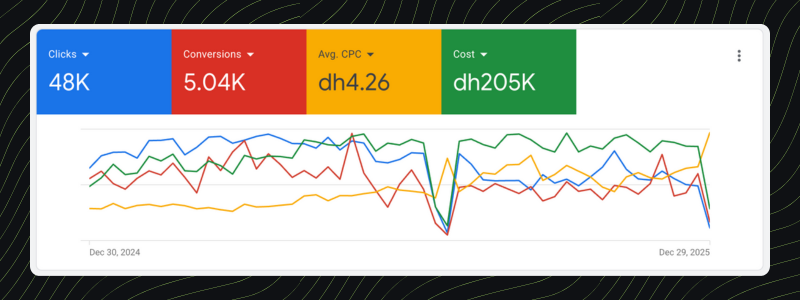
Total Clicks: 48,000+
Total Conversions: 5,040+ (Phone calls, WhatsApp clicks, and form submissions combined)
Average CPC: AED 4.26
Total Spend: AED 205,000+
Business Outcome
Consistent confirmed bookings
Controlled CPA across fluctuating demand
Stable performance despite seasonality and competition
CPC discipline was maintained throughout the year, which is uncommon in this niche and required continuous intent control and search term hygiene.
This account succeeded because it was treated as a system, not a campaign.
Key factors:
Clear separation between lead volume and real business success
Honest handling of conversion inflation
Strong alignment between ads, landing pages, and booking flows
Automation used to qualify, not just respond
Willingness to adjust without overreacting
Future optimization opportunities include:
Deeper segmentation between budget and premium safari intent
Stronger conversion value modeling tied to package price
More aggressive offline conversion weighting
Further refinement of WhatsApp and call-based intent signals
This was not a “growth hack” campaign.
It was a long-term, intent-driven Google Ads system designed to:
Survive seasonality
Handle real buyer behavior
Protect CPA while scaling
That is the difference between running ads and owning acquisition.